
What Is Evidence-Based Management?
‘Evidence-based’ is a term that was originally coined in the 1990s in the field of medicine, but today it’s principles extend across disciplines as varied as education, criminology, public policy, social work, and (recently) management.
The starting point for evidence-based management is that management decisions should be based on a combination of critical thinking and the best available evidence. And by ‘evidence’, we mean information, facts or data supporting (or contradicting) a claim, assumption or hypothesis. Evidence may come from scientific research, but internal business information and even professional experience can count as ‘evidence’. In principle, then, all managers base their decisions on ‘evidence’.
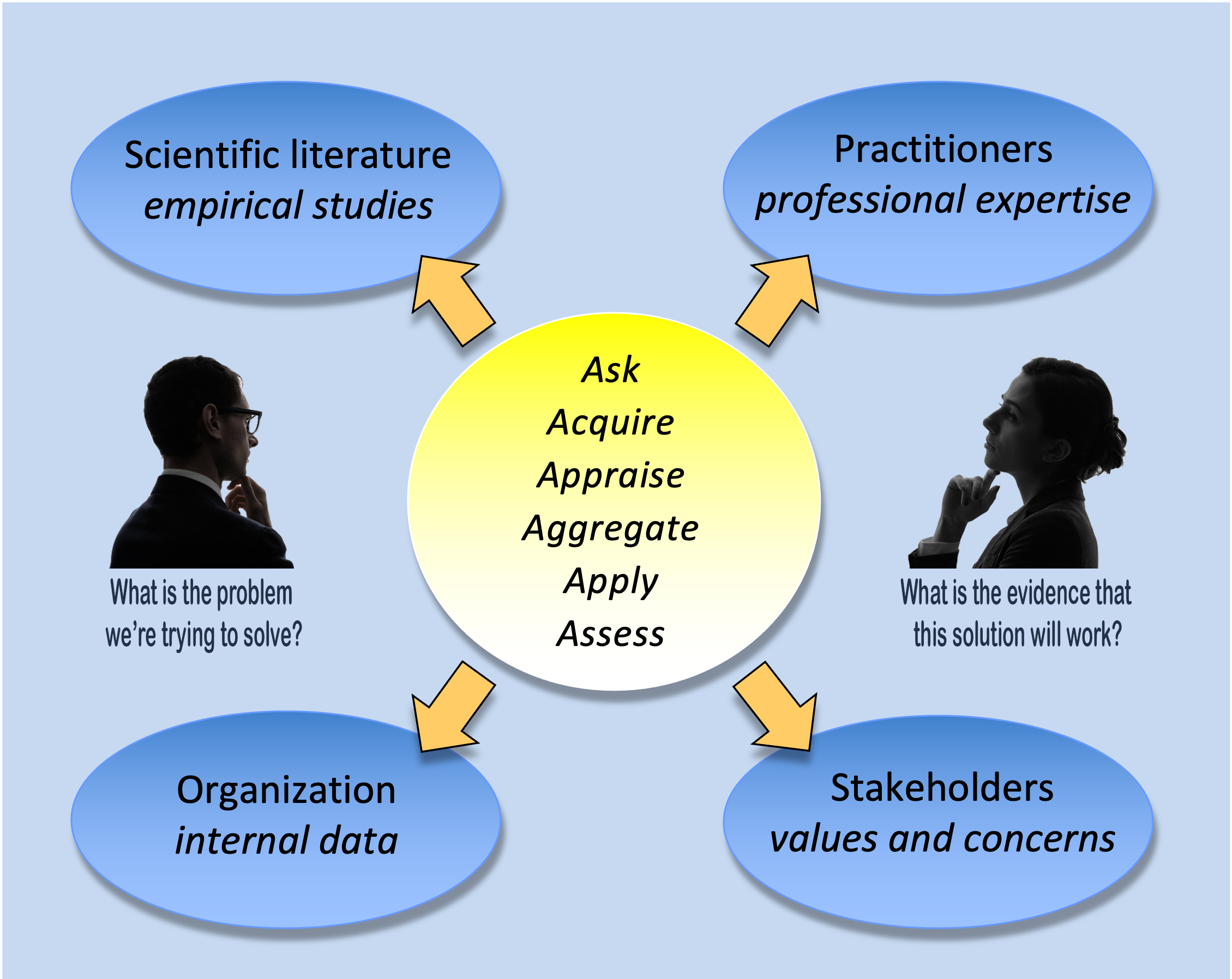
Many managers, however, pay little or no attention to the quality of the evidence they rely on to make decisions. As a result management decisions are often based on so-called ‘best practice’ and success stories of famous CEOs. Evidence-based practice seeks to address this state of affairs by helping managers to critically evaluate the validity, generalizability and applicability of the evidence they have in hand and how to find the ‘best available’ evidence.
In recent decades, a great deal of scientific research has been carried out involving issues relevant to management practice. Topics include downsizing, motivating employees, setting goals, encouraging entrepreneurship, managing mergers, using financial incentives, conducting management training, improving performance, and selecting and evaluating employees
To bring more scientific evidence into their decisions, managers need to know how to look for studies in online databases (or have staff who can), and learn how to evaluate the validity and applicability of the studies found. This is the reason why more and more universities and business schools have incorporated evidence-based practice into their curriculum. This process not only involves knowledge of the research field and methodology, but also – and particularly – teaching students and managers how to think scientifically in order to counterbalance to the subjectivity of their own judgement..
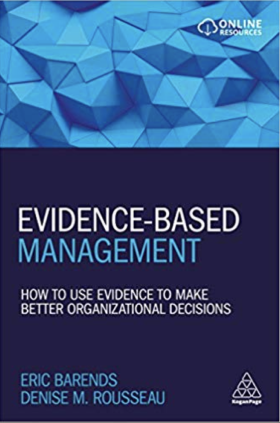
CEBMa Book
If you want to learn more about evidence based management, consider buying our book “Evidence-Based Management, How to Use Evidence to Make Better Organizational Decisions.

- Bargelaan 200
- 2333 CW Leiden
- The Netherlands


- Want to stay up to date?